































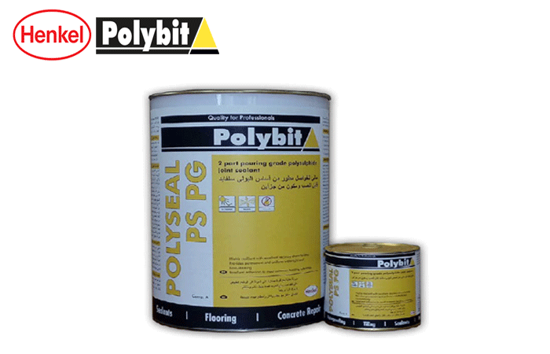
POLYSEAL PS PG
CHARACTERISTICS
► Highly resilient with excellent recovery characteristics
► Provides permanent and uniform watertight seal
► Non-staining
► Excellent resistance to fatigue and stays flexible throughout its service life–won’t become brittle, caulk or crack due to ultra violet exposure
► Prevents uncontrolled cracking by allowing expansion and contraction during temperature changes
► Excellent adhesion to most common building substrates
► Good resistance to ageing. Retains joint soundness once cured
► Resistance against mild chemicals, hydrocarbon fuels, sea water
► Non-toxic. Can be used in potable water applications, swimming pools
DESCRIPTION : Polyseal PS PG is a two component pourable, self leveling polysulphide resin based joint sealant. Polyseal PS PG is specifically designed to be used as a watertight seal for moderate movement and control joints in horizontal areas. It is based on a liquid polysulphide polymer which when mixed with the hardener, cures to form a tough, flexible and non staining rubber like seal. Polyseal PS PG has excellent adhesion to concrete, stone, metals and other common building surfaces. The cured sealant has good resistance to most environmental chemicals & resists deterioration on prolonged exposure to UV. Polyseal PS PG is suitable for use in horizontal areas with a maximum slope gradient of 10%. the sealant has a movement accomodation factor (MAF) of ±25%.
Fields of application : Sealing of movement and control joints in:
– structural floor joints
– airport runways and apron pavements
– industrial warehouses
– garages & workshops
– swimming pool floors
APPLICATION INSTRUCTIONS
Joint preparation : The joint surface must be clean, dry and free from oil, loose particles, cement laitance and other contaminants which may affect the adhesion. A thorough wire brushing, grinding, sand blasting or solvent cleaning may be required to expose a clean and sound substrate. The compressible joint filler shall be cut back to expose a uniform joint depth.
Priming : Primer should be applied to clean, dry surface prior to the installation of backer rod or bond breaking tape. Polyprime DUBAI GREEN BUILDING REGULATIONS Certi cate No. CL17020460 For illustration purpose only 2 PS* is recommended to be applied on porous substrates. For non-porous substrates such as steel or glass, use Polyprime NP* for optimum adhesion. The primer shall be applied by a brush in a thin coat application and shall be allowed to become tack free prior to the application of the sealant. The joint edges shall be re-primed if the sealant installation is not carried out within 3 hours of application of the primer. For obtaining a clean and neat finish, masking tape shall be applied on both the edges of the groove before applying the primer.
Back-up material : A bond breaking backing rod (Polyrod)* shall be inserted into all movement joints to avoid a three sided adhesion. Use of a backing rod will ensure proper joint depth and at the same time facilitate the formation of an hour glass profile on the applied sealant. The backer rod will also provide resistance to sealant tooling pressure and help to attain proper wetting of the substrate when the sealant is being tooled. The backing rod being inserted into the joint shall be of a diameter which is at least 20% larger but not greater 33% of the joint width. This will ensure that the backer rod remains in compression and in place during sealant installation. For static and joints where the depth is not sufficient for the use of the backing rod, a bond breaking tape may be applied to prevent the three side adhesion.
CAUTION: Do not damage or poke holes in the backer rod during or after installation, since this may cause air bubbles in the sealant and affect its performance.
MIXING & APPLICATION : Polyseal PS PG is supplied in pre-weighed two parts pack which requires on site mixing. Pour the hardener (part B) For illustration purpose only into the base (part a) pail and mix thoroughly with a slow speed drill (300-400 rpm) fitted to a flat bladed paddle for 1-2 minutes till a uniform colour and consistency is achieved. DO NOT PART MIX. Since the base and the curing agent ratio controls the ultimate physical properties like adhesion, durability and strength, one complete kit has to be mixed at a time. The side and base of the container shall be periodically scrapped with a scrapper to ensure that the curing agent is properly dispersed and blended in the mix. Pour the mixed material directly into the joint from the pail. Once the sealant has been installed a suitable rounded tool soaked in soapy water can be used to achieve an hour glass profile. Any masking tape applied should be removed immediately after the sealant is installed.
LIMITATIONS : Polyseal PS PG is not recommended for:
– vertical joints
– movement joints having maf >25%
– damp and contaminated surfaces
– asphalt pavements
– over painting (paint compatibility with sealant shall be checked prior to painting) 4Joints >50mm width
JOINT DESIGNS : The width of the joint should be a minimum of 4 times the anticipated movement. Joints with cyclic movement should have a width to depth ratio of 2:1 for butt joints and 1:1 for floor, static and lap joints. The joint depth shall not exceed the width. The joint width and depth should be maintained as recommended:
Joint Width
– 6 mm (minimum)
– 50 mm (maximum)
Joint depth
– 6 mm
– 20mm for heavily trafficked floor joints and areas exposed to hydrostatic pressure
CLEANING : Remove all excess sealant with a scraper. Any spillage can be cleaned using Polysolvent. Clean all tools and equipments using similar solvent immediately after the tooling. Hardened materials can be removed mechanically only.
MAINTENANCE : If the sealant is damaged but the bond is intact, cut out the damaged area and recaulk. If the bond has been affected, remove the sealant completely. Clean and prepare the joint in accordance with instructions under “Joint preparation” and recaulk. STANDARDS Polyseal PS PG complies with the requirements of: BS EN ISO 11600:2003 + A1:2011 (formerly BS 4254), BS 5212: Part 1, BS 6920 test on suitability with potable water, ASTM C 920 [Type M, Grade P, Class 25, USE T]
STORAGE & SHELF LIFE : Store in a cool, dry place and keep away from all sources of heat and sunlight. In tropical climates, store in air condition rooms. The shelf life is up to 12 months in unopened condition and if stored as per recommendations. Excessive exposure to sunlight, humidity and UV will result in the deterioration of the quality of the product and reduce its shelf life.
DISPOSAL : Mix separate product components in ratio and as supplied in suitable metal containers. Allow the mix to cure completely. Dispose as hazardous waste. It is recommended to use licensed waste disposal contractors and consult the local authority regarding the regulations.
HEALTH & SAFETY : As with all construction chemical products caution should be exercised. Contains manganese dioxide. Which is corrosive and may cause burns to skin if handled without proper protection. Refer the product msds for full details. Protective clothing such as gloves and goggles should be worn. Treat any splashes to the skin or eyes with fresh water immediately. Should any of the products be accidentally swallowed, do not induce vomiting, but call for medical assistance immediately.